
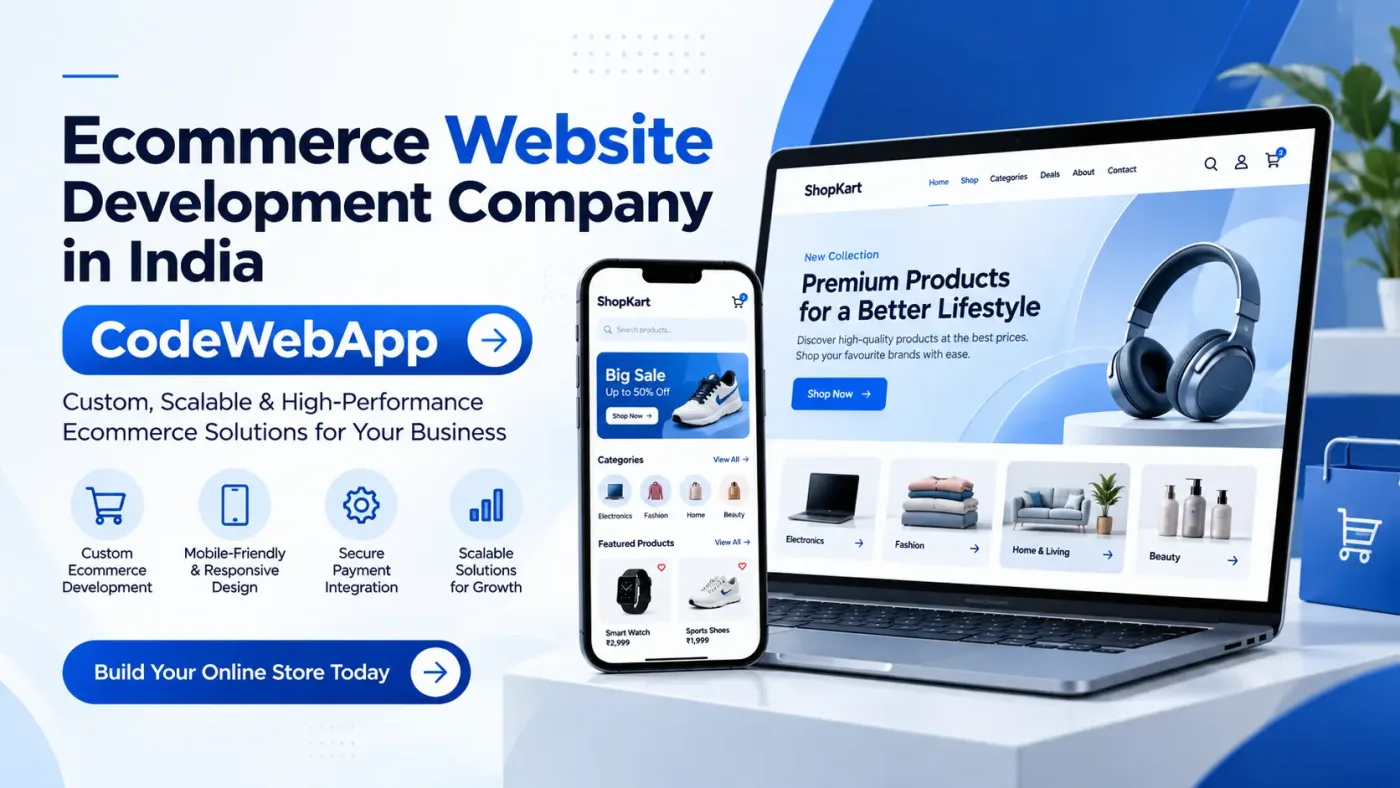
Code Web App is a leading ecommerce website development company in India, building custom, high-performing online stores on Shopify, and custom Coded On latest technology stacks.
Building an online store that actually converts visitors into paying customers takes more than picking a template and adding products. It takes the right technology stack, a design built around how people actually shop, and a development partner who understands both the technical and business side of ecommerce.
CodeWebApp is an ecommerce website development company in India based in Delhi, working with businesses that want a fast, secure, and scalable online store whether that's a new brand launching its first store or an established business migrating from an outdated platform. Below, you'll find direct answers to the questions businesses most commonly ask before hiring an ecommerce development company.
What Does an Ecommerce Website Development Company Do?
An ecommerce website development company designs, builds, and maintains the online store a business sells through covering everything from product catalog structure and checkout flow to payment gateway integration, hosting, and post-launch support.
Specifically, this work includes:
- Store architecture and UX design — organizing categories, navigation, and product pages so customers find what they need quickly
- Frontend and backend development — building the actual store using a chosen platform or custom code
- Payment gateway integration — connecting Razorpay, PayU, Stripe, or other gateways relevant to the target market
- Inventory and order management setup — syncing stock levels, order statuses, and fulfillment workflows
- Shipping and logistics integration — connecting with courier partners and calculating shipping costs dynamically
- Security implementation — SSL, PCI-DSS compliance considerations, and protection against common vulnerabilities
- Performance optimization — making sure pages load fast on both desktop and mobile
- Post-launch maintenance — bug fixes, plugin/library updates, and feature additions as the business grows
A good ecommerce development company doesn't just hand over a finished website — it builds a store that's easy for the business owner to manage day-to-day without needing a developer for every small change.
Why Do You Need a Professional Ecommerce Website Development Company in India?
You need a professional ecommerce website development company in India because a poorly built store directly costs you sales through slow load times, broken checkout flows, weak mobile experience, or security gaps that erode customer trust.
Here's what's at stake with ecommerce specifically:
1.First impressions happen fast. Most shoppers decide whether to stay or leave within a few seconds of a page loading.
- Cart abandonment is expensive. A confusing or slow checkout process is one of the most common reasons shoppers leave without buying.
3.Mobile traffic dominates. A large share of ecommerce traffic in India now comes from mobile devices, so a store that isn't properly optimized for mobile is losing a majority of potential buyers before they even browse.
4.Search visibility matters. A store built without attention to page structure, load speed, and clean code tends to struggle to rank, no matter how good the products are.
5.Scaling needs planning. A store built quickly on a rigid template often needs to be rebuilt entirely once the business grows past a certain order volume a proper technical foundation avoids that cost later.
Working with an experienced ecommerce development company india based means the foundation is built correctly the first time, with room to scale as the business grows, rather than needing a costly rebuild in a year or two.
What Makes CodeWebApp the Best Ecommerce Website Development Company in India?
What makes Code Web App stand out among options for the best ecommerce website development company in India is the combination of custom development capability, transparent process, and ongoing support rather than a one-time handoff.
Specifically:
- Platform flexibility — we're not locked into one platform, so recommendations are based on what actually fits the business, not what we're most comfortable selling
- Custom development expertise — beyond configuring existing platforms, we build fully custom ecommerce solutions on modern frameworks when a business's requirements go beyond what off-the-shelf platforms support
- Transparent, milestone-based process — clients see progress at defined stages rather than waiting for a single final delivery
- Performance-first approach — every store is built with page speed and Core Web Vitals in mind from day one, not fixed after launch
- Post-launch support — ongoing maintenance, updates, and feature additions after the store goes live
- Delhi-based team, pan-India clients — direct communication with the development team, not layers of account managers
As a custom ecommerce web development company, our goal is a store that fits the specific business model B2C, B2B, subscription, marketplace, or a hybrid rather than forcing the business into a generic template.
What Platforms Do We Use for Ecommerce Website Development?
The right platform depends on the business's catalog size, budget, customization needs, and growth plans there's no single "best" platform for every business.
WordPress and WooCommerce
As a WordPress ecommerce development company, we build stores on WooCommerce for businesses that want a content-driven store useful when blog content, SEO, and flexibility with plugins matter, and when the catalog size is small to mid-range. WooCommerce is cost-effective to set up and gives full ownership of the codebase and hosting.
Shopify
Shopify suits businesses that want a fully managed platform with minimal technical maintenance, reliable uptime, and a large ecosystem of apps for marketing, inventory, and fulfillment. It's a strong choice for brands that want to launch quickly and scale without managing server infrastructure.
Custom Development (Laravel, Next.js, Node.js, React.js, MERN Stack)
For businesses with specific workflow requirements custom pricing logic, complex product configurators, multi-vendor marketplace features, or integrations with existing ERP/CRM systems a fully custom build on Laravel or Next.js gives complete control over functionality and performance. This route costs more upfront but avoids the limitations that come with platform constraints as the business scales.
We walk businesses through this decision during the initial consultation rather than defaulting to one platform for every project the right fit depends entirely on catalog complexity, budget, and long-term plans.
What Services Are Included in Our Ecommerce Development Services?
Our ecommerce development services cover the full lifecycle of a store, not just the initial build:
- Ecommerce website design services — custom UI/UX design tailored to the brand, not template-based layouts
- Ecommerce website development — frontend and backend build on the chosen platform or custom stack
- Store migration — moving an existing store from one platform to another (for example, from a legacy platform to Shopify or WooCommerce) without losing SEO rankings, order history, or customer data
- Payment and shipping integration — connecting relevant gateways and logistics partners for the target market
- Custom feature development — product configurators, subscription models, loyalty programs, multi-currency support, or B2B-specific features like bulk ordering and tiered pricing
- Ecommerce app development — extending the store into a mobile app when a business needs a dedicated app presence alongside the website
- SEO-friendly technical setup — clean URL structures, schema markup, sitemap configuration, and fast-loading pages from the ground up
- Ongoing maintenance and support — security updates, bug fixes, and feature enhancements post-launch
Each engagement typically starts with a scoping call to identify which of these services the business actually needs, rather than bundling everything by default.
What Process Do We Follow as an Ecommerce Development Company in India?
The process we follow as an ecommerce development company in India is structured into clear phases so the business always knows what stage the project is at and what's coming next.
6.Discovery and requirement mapping — understanding the product catalog, target customers, competitors, and must-have features
7.Platform and technology selection — recommending WordPress, Shopify, or a custom build based on the discovery phase findings
8.Wireframing and UI/UX design — laying out the store structure and visual design before development begins
9.Development — building the store in stages, with staging-environment reviews at key milestones
10.Integration — connecting payment gateways, shipping providers, and any third-party tools (CRM, email marketing, analytics)
11.Testing — checking functionality, payment flows, mobile responsiveness, and load speed across devices and browsers
12.Launch — going live with proper redirects (for migrations), tracking setup, and a final pre-launch checklist
13.Post-launch support — monitoring, bug fixes, and iterative improvements based on real user behavior
This staged approach means clients see and approve work at each step, rather than discovering issues only after the full build is complete.
Which Industries Do We Build Ecommerce Websites For?
We build ecommerce stores across a range of industries, each with different technical and UX requirements:
- Fashion and apparel — size guides, variant selection, lookbooks, and visual-heavy product pages
- Electronics and gadgets — detailed spec comparisons, filters, and warranty/service information
- Grocery and FMCG — subscription and recurring-order features, delivery-slot selection, and inventory sync
- Home decor and furniture — high-resolution imagery, room-visualization tools, and shipping calculators for bulky items
- B2B and wholesale — bulk ordering, tiered/negotiated pricing, and account-based access
- Beauty and personal care — ingredient listings, subscription models, and loyalty programs
- Handicrafts and D2C brands — storytelling-focused design paired with a clean, conversion-optimized checkout
Each industry has different priorities a grocery store lives or dies on delivery logistics and repeat-order convenience, while a fashion store depends more on visual merchandising and easy returns. We tailor the build to what actually drives conversions in that specific category.
How Is Ecommerce App Development Different from Website Development?
Ecommerce website development builds a store accessible through any browser, while ecommerce app development builds a dedicated mobile application installed directly on a customer's phone, typically offering push notifications, faster repeat-browsing speed, and deeper integration with device features.
A website is usually the right starting point because it's accessible to everyone immediately, ranks in search engines, and costs less to build and maintain. An app becomes worth the additional investment once a business has an established, repeat-purchasing customer base and wants to increase retention through push notifications and a more app-like shopping experience. Many businesses run both together the website drives new-customer acquisition and search visibility, while the app supports loyalty and repeat purchases. As an ecommerce app development company alongside our website development services, we help businesses decide when that second investment actually makes sense rather than recommending it by default.
What Should You Look for in a Custom Ecommerce Development Company?
When evaluating a custom ecommerce development company, look beyond portfolio screenshots and check for these specifics:
- Relevant technical stack experience — ask directly which platforms and frameworks they've built on, not just which ones they list on their website
- Ownership of code and assets — confirm you'll have full access to the codebase, hosting, and admin credentials after launch, not vendor lock-in
- Post-launch support terms — clarify what's included after go-live and for how long, since most issues surface only after real customer traffic hits the store
- Clear, staged pricing — a company that breaks down cost by phase (design, development, integration, testing) is easier to budget against than one quoting a single lump sum
- Communication process — direct access to the development team, rather than routing every question through account managers, tends to resolve issues faster
- Security practices — ask specifically how they handle payment data, SSL setup, and vulnerability testing before launch
A reliable ecommerce solution company will walk through these points proactively during the first conversation, rather than requiring you to ask.
How Much Does Ecommerce Website Development Cost in India?
Ecommerce website development cost in India typically ranges from roughly ₹40,000–₹1,50,000 for a WordPress/WooCommerce store with standard features, ₹80,000–₹3,00,000+ for a Shopify build with custom design and app integrations, and ₹3,00,000 and upward for a fully custom-developed store with advanced features.
The exact cost depends on several factors:
- Catalog size — a 50-product store costs significantly less to set up than a 5,000-product catalog requiring bulk import tools and advanced filtering
- Design complexity — a fully custom UI costs more than a well-adapted existing theme
- Custom features — subscription billing, multi-vendor support, or ERP integration add development time
- Platform choice — custom-built stores generally cost more upfront than platform-based stores but offer more long-term flexibility
- Third-party integrations — payment gateways, shipping APIs, CRM, and marketing tool connections each add scope
We provide a detailed quote after the discovery call once catalog size, feature list, and platform are confirmed general estimates online rarely reflect what a specific business actually needs.
Why Choose a Local Ecommerce Development Company in India Over Global Agencies?
Choosing a local ecommerce development company india-based over a global agency generally means lower cost for comparable quality, faster response times due to time-zone alignment, and better understanding of India-specific requirements like local payment gateways, GST-compliant invoicing, and regional logistics providers.
That said, this isn't about India-based always being the better choice in every case — it depends on what the business needs:
Factor | India-Based Company | Global/Overseas Agency |
Cost | Generally lower for comparable scope | Typically higher hourly/project rates |
Time-zone communication | Same/overlapping working hours for India-based clients | Often delayed responses across time zones |
Local payment gateway expertise | Strong (Razorpay, PayU, Cashfree) | Variable, often less familiar |
GST/compliance-aware invoicing | Usually built-in | Often needs custom handling |
Global market experience | Growing, especially for outsourced projects | Often stronger for very large-scale, multi-region stores |
For most small and mid-sized businesses selling primarily within India, or businesses abroad looking to outsource development at a lower cost without sacrificing quality, a India-based ecommerce website development company offers a strong balance of cost, communication, and local expertise.
