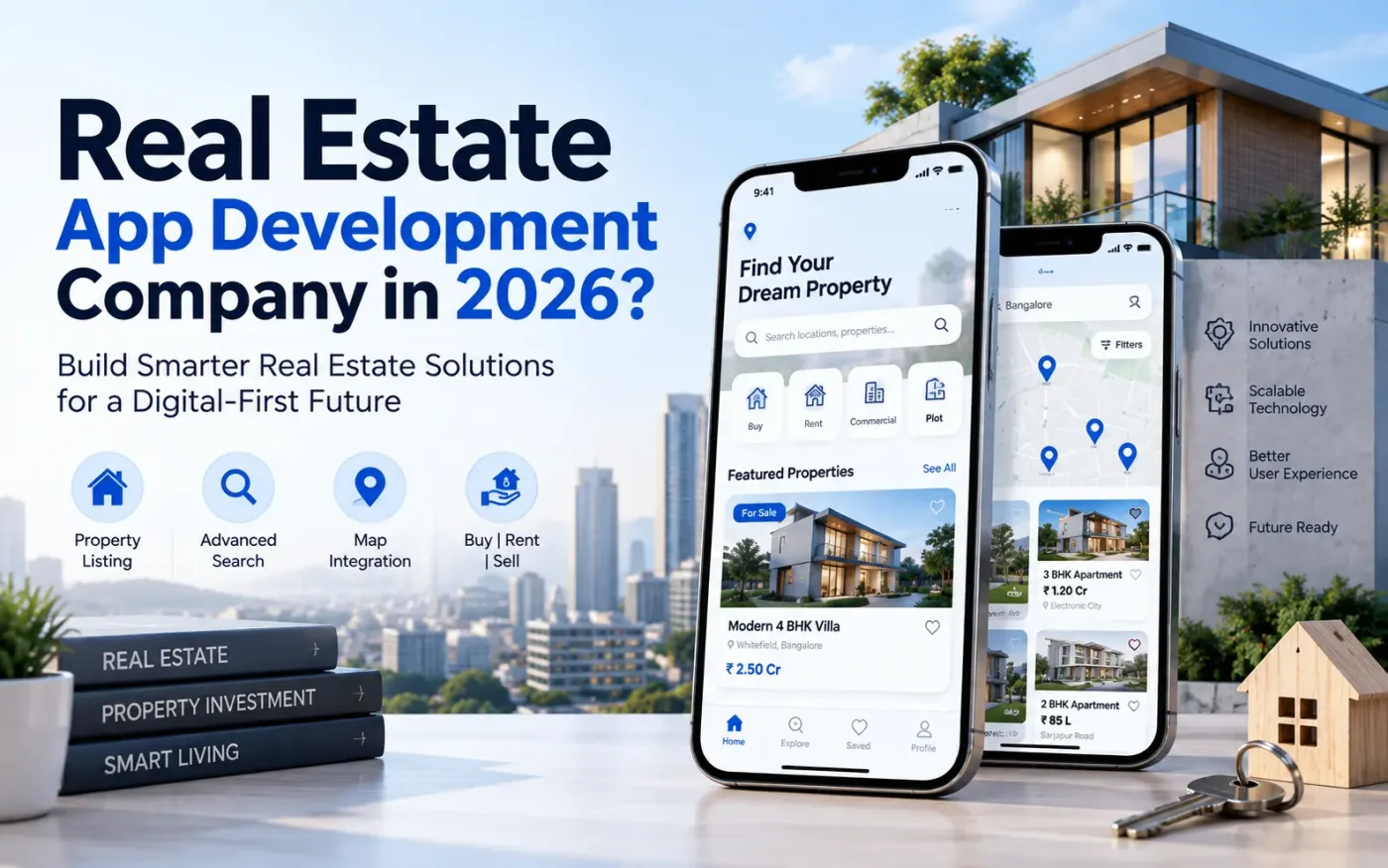
Looking for a real estate app development company? Learn app types, features, cost in India, timeline, and how to choose the right partner in 2026.
How to Choose a Real Estate App Development Company in 2026?
A real estate app development company designs, builds, launches, and maintains property apps such as listing portals, agent CRMs, and property management tools. In India, a custom app usually costs between ₹6 lakh and ₹60 lakh and takes 2 to 12 months, depending on features, platforms, and integrations. Pick a partner with proven property projects, a clear process, and post-launch support.
This guide covers app types, features, cost, timeline, monetization, the development process, compliance, and how to shortlist the right partner.
What Is a Real Estate App and How Does It Work in India?
A real estate app is a mobile or web application that connects buyers, sellers, tenants, landlords, and agents on one platform. Users search verified properties, contact owners, book site visits, and track deals, while an admin panel manages listings, leads, and payments.
Indian portals such as 99acres, MagicBricks, Housing.com, and NoBroker have taught buyers to start their property search on a phone. That habit is why developers, brokers, and proptech startups now want their own apps instead of depending only on third-party listings.
Every real estate app has three connected parts. The user app serves buyers and tenants. The agent or owner app handles listings, enquiries, and follow-ups. The admin panel and backend control data, approvals, analytics, and integrations. A good real estate app development company builds all three as one system so that a lead captured on the user app reaches the right agent within seconds.
What Does a Real Estate App Development Company Do?
A real estate app development company plans, designs, codes, tests, launches, and maintains property apps for developers, brokers, and proptech startups. Many also provide real estate software development services, including CRM, ERP, and property management systems built around a client's workflow.
The work usually covers business analysis, UI/UX design, backend and API development, third-party integrations such as maps, payment gateways, and CRMs, quality testing, and app store publishing. After launch, the team handles bug fixes, security updates, and new features.
The difference between a general app agency and a specialist real estate software development company is domain knowledge. A specialist already understands lead cycles, site visits, booking amounts, and RERA requirements, so fewer requirements get lost in translation and the first version is closer to what the market expects.
What Types of Real Estate Apps Can a Company Build?
Companies build property listing apps, agent CRMs, property management apps, and rental apps. Each serves a different user, so the feature set, timeline, and budget change with the type. Choosing the right type first prevents expensive rework later.
What Is a Property Listing App?
A property listing app lets owners, builders, and agents publish properties while buyers search by location, budget, and BHK. Housing.com and 99acres are well-known examples. Revenue usually comes from paid listings, featured placements, and lead sales.
What Is a Real Estate CRM App for Agents?
A real estate CRM app helps agents capture leads, schedule site visits, send follow-up reminders, and track every deal stage from one dashboard. It is one of the most useful forms of software for real estate professionals because it replaces spreadsheets and scattered WhatsApp chats.
What Is a Property Management App?
A property management app helps landlords, housing societies, and facility teams manage tenants, rent collection, maintenance tickets, and documents. Demand for property management software development service keeps rising as more owners manage multiple units across cities.
What Is a Rental and Tenant App?
A rental app connects landlords and tenants for listings, digital rent agreements, online payments, and reminders. It suits co-living brands, student housing operators, and PG owners who need to manage many small units efficiently.
What Is a Real Estate Investment App?
A real estate investment app lets users explore projects, compare expected returns, and invest through fractional or REIT-style models where regulations allow. These products need stronger KYC, document handling, and compliance checks than a standard listing app.
What Features Should a Real Estate App Have?
A real estate app should include advanced property search, map view, saved listings, enquiry forms, chat, push notifications, and an admin dashboard. Advanced features such as AI recommendations and virtual tours help your product stand apart from basic listing apps.
What Are the Must-Have Features?
- Property search with filters for location, price, property type, and BHK.
- Map view showing nearby schools, hospitals, metro stations, and markets.
- Property detail pages with photo galleries, floor plans, and walkthrough videos.
- Save, compare, and share options so buyers can shortlist properties with family.
- Enquiry forms with call and WhatsApp buttons for instant contact.
- Push notifications for new listings, price drops, and visit reminders.
- OTP login and user profiles to keep accounts secure and lead data verified.
- Admin dashboard for listing approval, lead tracking, and reports.
Which Advanced Features Add Value?
Advanced features raise engagement and conversion. AI property recommendations match users to listings based on their browsing behavior. Virtual and 3D tours reduce unnecessary site visits. EMI calculators help buyers plan budgets, and in-app chat with agents shortens response time, which directly improves lead conversion.
Feature | Buyer App | Agent App | Admin Panel |
Property search and filters | Yes | Yes | Yes |
Listing creation | No | Yes | Yes |
Listing approval | No | No | Yes |
Lead management | No | Yes | Yes |
Chat and notifications | Yes | Yes | Yes |
Analytics dashboard | No | Basic | Full |
Should You Choose Custom Real Estate Software or a Ready-Made App?
Choose custom real estate software if you need unique workflows, brand control, and long-term scalability. Choose a ready-made app only for quick validation on a small budget. Most growing businesses outgrow templates within a year because they cannot change the logic behind lead routing, pricing, or integrations.
Factor | Custom Software | Ready-Made App |
Ownership | Full source code | Controlled by the vendor |
Scalability | Built for your growth | Limited by the template |
Integrations | Any CRM, ERP, or API | Limited options |
Upfront cost | Higher | Lower |
Time to launch | 2 to 6 months | 2 to 4 weeks |
Businesses that invest in custom real estate software development also avoid recurring per-user licence fees that grow every time the sales team expands.
How Much Does Real Estate App Development Cost and How Long Does It Take?
In India, real estate app development costs about ₹6 lakh to ₹60 lakh or more and takes 2 to 12 months. The final price depends on features, platforms, design complexity, and integrations. Starting with an MVP is the most affordable way to test the market.
App Level | What You Get | Estimated Cost | Timeline |
MVP | Listings, search, login, enquiry form, basic admin panel | ₹6 to ₹12 lakh | 2 to 3 months |
Mid-level | Agent app, CRM, chat, payments, analytics | ₹12 to ₹30 lakh | 4 to 6 months |
Enterprise | AI features, virtual tours, multi-city support, ERP integration | ₹30 to ₹60 lakh or more | 6 to 12 months |
Several factors move the price up or down:
- Platforms: Android only, iOS only, both, or both plus a web version.
- User roles: buyer, agent, owner, builder, and admin each need their own screens.
- Integrations: payment gateways, maps, CRM, SMS, and WhatsApp APIs.
- Design depth: custom UI/UX and animations cost more than standard layouts.
- Advanced technology: AI, AR, and 3D tours add development and testing time.
- Maintenance: usually 15 to 20 percent of the build cost per year.
These figures are estimates for planning. Ask any real estate app development company for a written scope and an itemized quote before you sign.
To control cost, launch with the features that capture leads first, such as search, enquiry, and an admin panel. Add chat, AI recommendations, and virtual tours after real users show which features they actually use.
Need an accurate quote for your real estate app?
Share your requirements with Code Web App and get a free consultation with a feature list, timeline, and estimate. Get a free consultation
How Do Real Estate Apps Make Money?
Real estate apps earn through listing fees, subscription plans, lead generation, featured listings, commissions, and advertising. Most successful platforms combine two or three models instead of relying on a single source of revenue.
- Listing fees: owners or builders pay to publish properties.
- Subscriptions: agents pay monthly for leads, CRM tools, and analytics.
- Lead generation: builders pay for verified buyer enquiries.
- Featured listings: paid placement at the top of search results.
- Commissions: a fee on rentals or closed sales.
- Advertising: banners from banks, interior designers, and packers and movers.
What Are the Latest Trends in Real Estate App Development?
The biggest trends are AI-based recommendations, virtual property tours, regional language support, and smart home connectivity. Apps that adopt these early give users a faster, more trusted way to find a property.
AI and chatbots answer buyer questions at any hour and qualify leads before they reach an agent. Virtual and 3D tours let out-of-town and NRI buyers shortlist properties without travelling. Voice search and regional languages such as Hindi make apps usable for buyers beyond English-speaking metros. Smart home and IoT integration connects apps with door locks, meters, and security systems for rental and managed properties.
What Is the Real Estate App Development Process?
The process has six stages: discovery, UI/UX design, development, testing, launch, and maintenance. A clear plan with milestones keeps the cost and timeline predictable and lets you review progress at every stage.
How Does Discovery and Research Work?
The team studies your users, competitors, and business model, then finalizes features, tech stack, and a project roadmap. The deliverable is a requirement document with a fixed scope.
What Happens in UI/UX Design?
Designers create wireframes and clickable prototypes for search, listing, and enquiry flows. You approve every screen before coding begins, which avoids costly changes later.
How Is the Real Estate App Developed?
Developers build the frontend, backend, APIs, and admin panel in short sprints. You receive a working demo every one to two weeks and can request changes early.
How Is the App Tested Before Launch?
QA engineers test features, speed, security, and behavior across devices and operating systems. Bugs are fixed and retested before anything reaches the app stores.
How Does the App Launch?
The team publishes the app on Google Play and the Apple App Store, sets up analytics and crash reporting, and monitors early user feedback closely.
What Support Follows After Launch?
Maintenance includes bug fixes, operating system updates, server monitoring, and new features based on real usage data. Ask for a support plan in writing.
What Are the Biggest Challenges in Building a Real Estate App?
The biggest challenges are listing accuracy, lead quality, app speed with heavy images, and data security. Planning for these before development starts prevents the problems that make users abandon property apps.
Listing accuracy: Fake or outdated listings destroy trust quickly. Build a verification flow, expiry dates for listings, and a report button. Lead quality: Unverified phone numbers waste agent time, so use OTP login and duplicate lead checks. Performance: Property photos and videos are heavy. Use image compression, lazy loading, and a content delivery network so search results load quickly on mobile data. Security: Apps store phone numbers, addresses, and documents, so encryption, role-based access, and regular security testing are essential.
Which Tech Stack and Compliance Rules Apply to a Real Estate App?
Flutter or React Native suits most cross-platform real estate apps, paired with a Laravel or Node.js backend and a MySQL or PostgreSQL database. Compliance also matters: Indian apps should follow RERA advertising rules and the Digital Personal Data Protection Act, 2023.
Layer | Common Options |
Mobile app | Flutter, React Native, Kotlin, Swift |
Backend | Laravel, Node.js |
Database | MySQL, PostgreSQL |
Maps and location | Google Maps Platform |
Payments | Razorpay, PayU |
Cloud hosting | AWS, Google Cloud |
RERA requires registered projects to display their registration number in advertisements, so listing forms should include a RERA ID field. Under the DPDP Act, apps must obtain user consent for personal data and protect it properly. Confirm current rules with a legal advisor before launch.
How to Choose the Right Real Estate App Development Company?
Shortlist companies with real estate portfolio projects, a transparent process, verifiable client reviews, and post-launch support. Compare at least three quotes and get a written scope before signing any contract.
When proposals arrive, compare them line by line: feature list, platforms, tech stack, timeline, support period, and payment milestones. The lowest quote often leaves out the admin panel, testing, or support, and you end up paying for those later.
What Should You Check in Their Portfolio?
Look for live apps you can download, not only screenshots. Test search speed, listing quality, and design consistency. Ask for references from clients in property or a similar marketplace niche and speak to them directly.
What Questions Should You Ask Before Hiring?
- Who owns the source code after delivery?
- How do you handle scope changes during development?
- What is included in post-launch support and for how long?
- Which team members will work on my project?
- How do you secure user data and property documents?
What Are the Red Flags?
- A fixed price quoted without any requirement discussion.
- No live projects or client references to show.
- Refusal to share source code or hosting access.
- No testing or QA process.
- Vague answers about maintenance costs.
Comparing real estate app development companies?
Talk to the Code Web App team. We will review your idea, suggest the right feature set, and share a clear estimate. Contact Code Web App
Why Choose Code Web App as Your Real Estate App Development Company in Delhi?
Code Web App is a Delhi-based team that builds websites, mobile apps, and search-ready digital products under one roof. Our mobile app development company in Delhi services cover discovery, design, development, testing, and support, with a written scope and milestone-based delivery.
Because we also handle SEO, your property app and its web listings can be built to rank on Google from day one, which lowers your cost of acquiring buyers and tenants
Which Is the Best Real Estate App Development Company in India?
The best choice depends on your goals, budget, and required features. Shortlist companies with live property projects, transparent pricing, and post-launch support, then compare at least three proposals.
Can I Build an App Like Zillow or 99acres?
Yes. A listing marketplace needs search, maps, multiple user roles, lead management, and payments. Start with an MVP and add features as traffic and revenue grow.
Do I Need a Mobile App or a Website First?
If your users search on phones, start with a mobile app or a responsive web app. Many businesses launch a web version first to validate demand, then build the mobile app.
What Is an MVP in Real Estate App Development?
An MVP is the first working version with only core features such as search, listings, and enquiry. It lets you launch faster, gather user feedback, and invest in advanced features only after the market responds.
What Is the Cost of Maintaining a Real Estate App?
Maintenance usually costs 15 to 20 percent of the build cost each year, covering hosting, updates, bug fixes, and security patches.
Can the App Integrate With My Existing CRM?
Yes. Most apps connect with CRMs such as Zoho, HubSpot, and Salesforce through APIs, so new leads sync automatically and no data is entered twice.